by R. H. S. Crossman (Esquire Magazine – November 1963)
The long suppressed story of the worst massacre in the history of the world.
 If the British Commonwealth and the United States last a thousand years, men may say that this was their darkest hour.
Were all the crimes against humanity committed during World War II the work of Hitler’s underlings? That was certainly the impression created by the fact that only Germans were brought to trial at Nüremburg. Alas! It is a false impression. We all now know that in the terrible struggle waged between the Red Army and the German Wehrmacht, the Russians displayed their fair share of insensate inhumanity. What is less widely recognized — because the truth, until only recently, has been deliberately suppressed — is that the Western democracies were responsible for the most senseless single act of mass murder committed in the whole course of World War II.
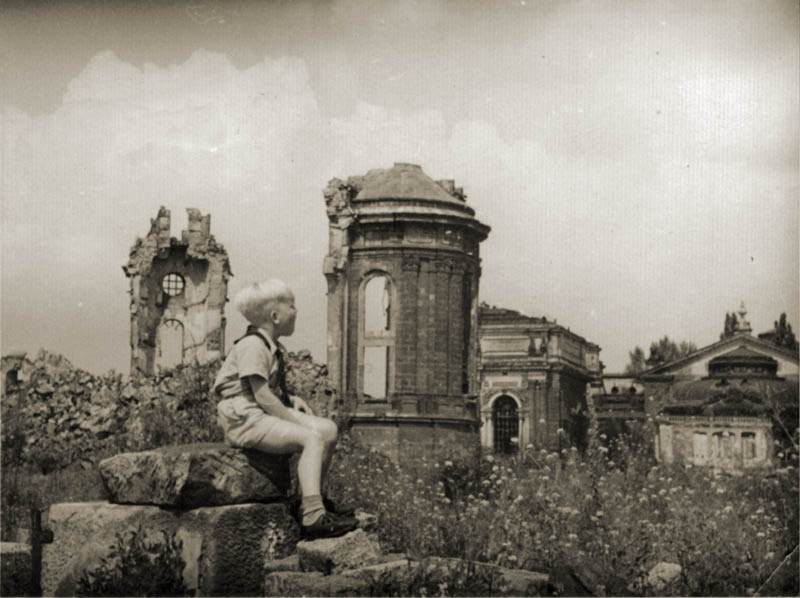
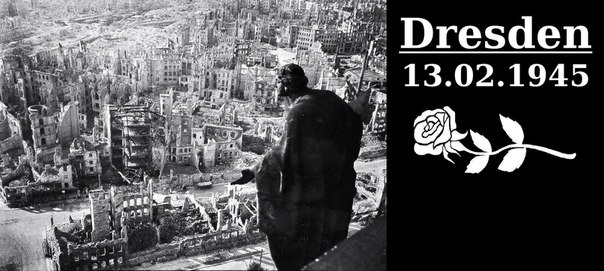
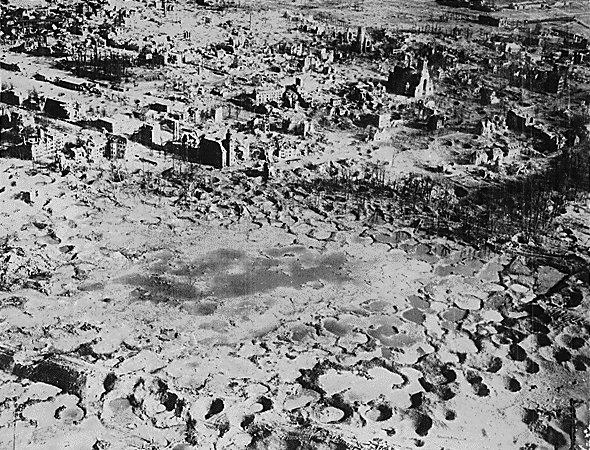
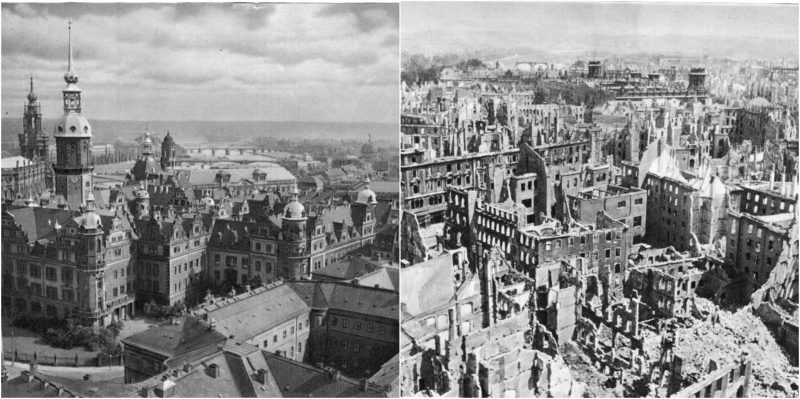
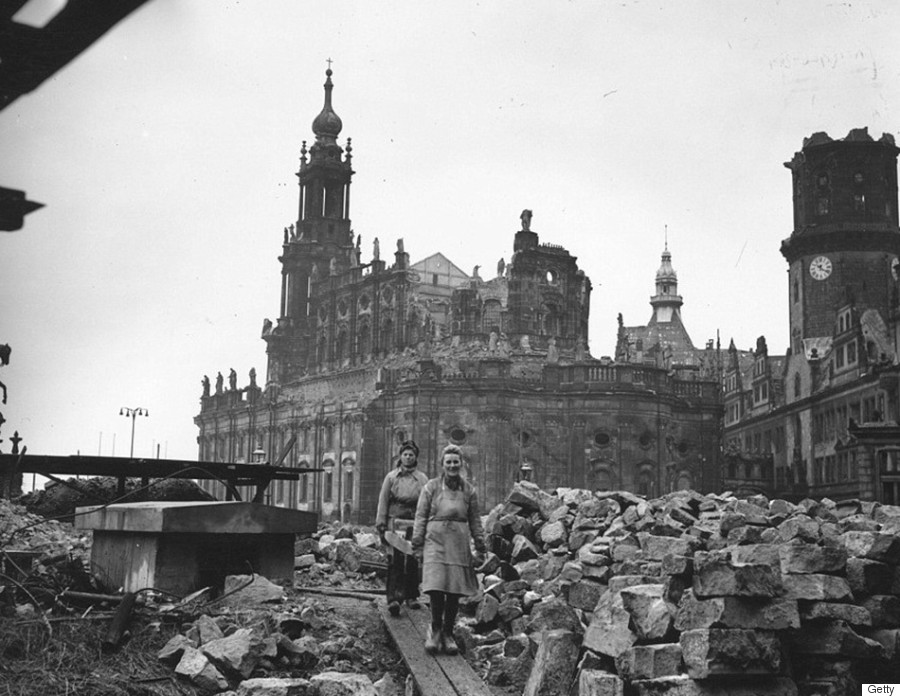
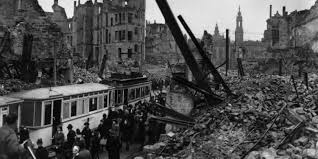
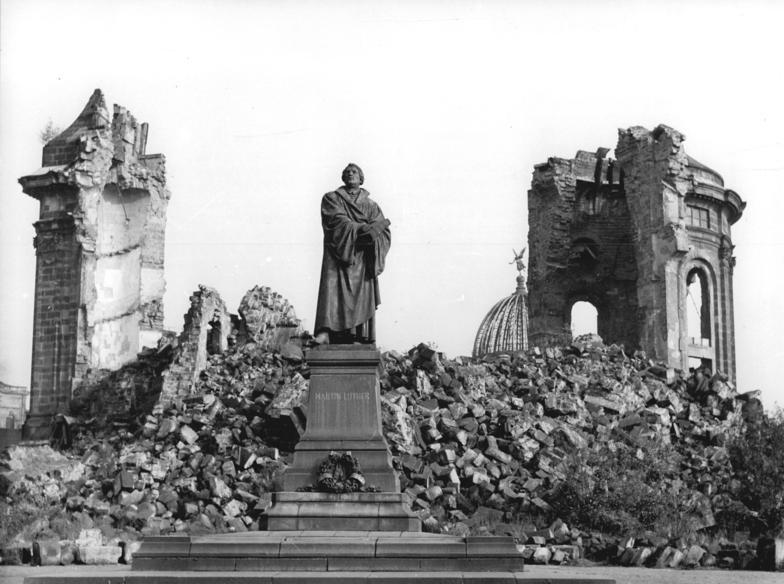
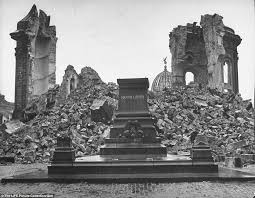
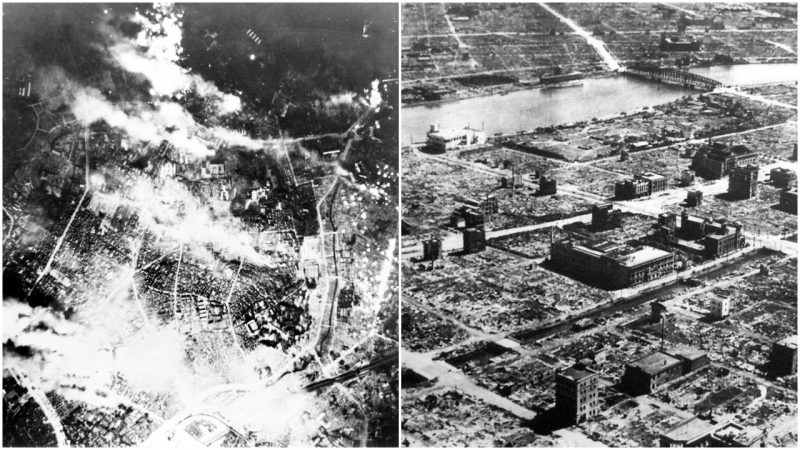
The devastation of Dresden in February, 1945, was one of those crimes against humanity whose authors would have been arraigned at Nüremburg if that Court had not been perverted into the instrument of Allied justice. Whether measured in terms of material destruction or by loss of human life, this “conventional” air raid was far more devastating than either of the two atomic raids against Japan that were to follow it a few months later. Out of 28,410 houses in the inner city of Dresden, 24,866 were destroyed; and the area of total destruction extended over eleven square miles.
 As for the death roll, the population, as we shall see, had been well nigh doubled by a last-minute influx of refugees flying before the Red Army; and even the German authorities — usually so pedantic in their estimates — gave up trying to work out the precise total after some 35,000 bodies had been recognized, labeled and buried. We do know, however, that the 1,250,000 people in the city on the night of the raid had been reduced to 368,619 by the time it was over; and it seems certain that the death roll must have greatly exceeded the 71,879 at Hiroshima. Indeed, the German authorities were probably correct who, a few days after the attack, put the total somewhere between 120,000 and 150,000.
How was this horror permitted to happen? Was it a deliberate and considered act of policy, or was it the result of one of those ghastly misunderstandings or miscalculations that sometimes occur in the heat of battle? There are many who will say that these are academic questions belonging to history. I do not agree. Of course, what happened at Dresden belongs to the prenuclear epoch. But it has a terrible relevance to the defense strategy which the Western democracies are operating today. If the crime of Dresden is not to be repeated on a vaster scale, we must find out why it was committed. That, at least, has been my feeling, and there are two special reasons which have prompted me to go on investigating the facts for so many years. In the first place, I was myself involved in a quite minor capacity in the decisions which preceded it. When the Germans overran France in 1940 and the Chamberlain Government in London was replaced by the Churchill Government, there was a purge in Whitehall. Unexpectedly I found myself recruited to a secret department attached to the Foreign Office, with the title “Director of Psychological Warfare against Germany.” My main task was to plan the overt and subvert propaganda which we hoped would rouse occupied Europe against Hitler. But I soon found myself caught up in a bitter top-secret controversy about the role of bomber offensive in the breaking of German morale.
The Prime Minister was haunted by fears that the bloodletting of the Somme and Passchendaele in World War I would have to be repeated if we tried to defeat Hitler by landing and liberating Europe. So the Air Marshals found it easy to persuade him that if they were given a free hand they could make these casualties unnecessary by smashing the German home front into submission. What Hitler wreaked against London and Coventry, our bombers would repay a thousandfold, until the inhabitants of Berlin, Hamburg and every other city in Germany had been systematically “de-housed” and pulverized into surrender. To achieve this, the Air Marshals demanded that top priority in war production should be given not to preparations for the second front, but to the construction of huge numbers of four-engined night bombers.
 Eagerly Sir Winston Churchill accepted their advice, with the backing of his whole Cabinet. The only warning voices raised were those of a number of very influential scientists who, by means of careful calculations, threw serious doubt on the physical possibility of wreaking the degree of destruction required. Their mathematical arguments were reinforced by the studies we psychological warriors had made of British morale in the blitz. Assuming, wisely as it worked out, that the German people would behave under air attack at least as bravely as the British people, we demonstrated that the scale of frightfulness our bombers could employ against German cities would almost certainly strengthen civilian morale, and go stimulate the war production that it was intended to weaken.
Early in 1941, these arguments were finally swept aside, and Britain was completely committed to the bomber offensive. By the time it reached its first climax in the raid on Hamburg, however, I had been transferred to Eisenhower’s staff. I was happy, first in North Africa and then in SHAEF, to work with an Anglo-American staff who did not trouble to conceal how much they detested the hysterical mania for destruction and the cold-blooded delight in pounding the German home front to pieces displayed by the big-bomb boys. Indeed, one of my pleasantest memories is the attitude General Walter Bedell Smith displayed a few weeks after the Dresden raid. Sir Winston had accused “Ike” of being soft to the German civilians and ordered him to use terror tactics in order to panic them out of their homes and onto the roads, and so to block the German retreat. No one contradicted Sir Winston, but as soon as his back was turned, we were instructed to work out a directive that would prevent him getting his way.
 On V.E. Day, when I flew back to Britain in order to stand as a Labour Candidate in Coventry, I assumed with relief that my concern with bombing was over. But I was wrong. Within years, Coventry — the main victim of the Luftwaffe — had “twinned” itself with Dresden, the main victim of the R.A.F. And when Germany was divided and it became difficult for Westerners to go behind the Iron Curtain, I had a standing invitation to visit Dresden as the guest of its Lord Mayor. I have done so frequently, and on each occasion I have tried to match the inside experience of bombing strategy I acquired during the war with firsthand information from its victims “on the other side of the hill.” I have also checked the published accounts of the destruction of Dresden available in Western and Eastern Germany, against the official History of the Strategic Bombing Offensive published only two years ago in Britain. These researches have left me in no doubt whatever how Dresden was destroyed, why it was destroyed, and what lessons we must draw from its destruction.
The prelude to the bombing of Dresden was sounded by the Russian communique of January 12, 1945, which announced that the Red Army had resumed its offensive all along the front, and was advancing into Prussia and Silesia. This news could hardly have been more embarrassing, either to General Dwight D. Eisenhower whose armies were still recovering from the humiliating effects of General Karl von Rundstedt’s Christmas offensive in the Ardennes, or to President Franklin D. Roosevelt and Prime Minister Churchill who were now preparing for the Yalta Conference due to start on February 4. Since the post war settlement was bound to be discussed with Josef Stalin in terms not of principle but of pure politics, Sir Winston felt that the impression created by the Red Army’s occupation of Eastern Europe and advance deep into Germany must somehow be countered. But how? The obvious answer was by a demonstration right up against the Red Army of Western air power. What was required, he decided, was a thunderclap of Anglo-American aerial annihilation so frightful in the destruction it wreaked that even Stalin would be impressed.
January 25 was the day when the decision was taken that resulted in the blotting out of Dresden. Until then, the capital of Saxony had been considered so famous a cultural monument and so futile a military target that even the Commander in Chief of Bombing Command, Air Marshal Sir Arthur Harris, had given it hardly a thought. All its flak batteries had been removed for use on the Eastern front; and the Dresden authorities had taken none of the precautions, either in the strengthening of air-raid shelters, or in the provision of concrete bunkers that had so startlingly reduced casualties in other German cities subjected to Allied attack. Instead, they had encouraged rumors that it would be spared either because Churchill had a niece living there, or else because it was reserved by the Allies as their main occupation quarters. These rumors were strengthened by the knowledge that no less than some 26,000 Allied prisoners were quartered in and around the city, and that its population had doubled to well over a million in recent weeks by streams of refugees from the East.
 All this Sir Winston knew on January 26. But early on that winter morning he had learned that the Russian Army had crossed the Oder at Breslav and was now only sixty miles from Dresden. Angrily he rang up Sir Archibald Sinclair, his Secretary of State for Air, and asked him what plans he had for “basting the Germans — in their retreat from Breslav.” Sir Archibald, whose main function it had been to protect Bomber Command from public criticism by a series of lying assurances that scrupulous care was taken to bomb only military targets, remained true to type. He prevaricated over the phone and next day replied that in the view of the Air Staff “intervention in winter weather at very long range over Eastern Germany would be difficult.” To this the Premier replied with a memorandum so offensive in its controlled fury that the Minister and the Air Staff, never noted for their moral courage, were stampeded into action. At once, orders were given to concert with the American Eighth Air Force a plan for wiping out Leipzig, Chemnitz and Dresden.
 Sir Winston and his staff left for Yalta, where it became only too clear that the Premier’s forebodings were justified. Strengthened by his victories, Stalin pressed his political demands upon a President now weakened and very near his death, and a Prime Minister isolated and ill at ease. When suggestions were made that the Western bombing should be used to help the Red Army advance, the Russian generals were chilly and unresponsive. Nevertheless, Sir Arthur Harris had already selected Dresden, now only sixty miles from the front, for destruction. And day by day, Sir Winston hoped that he would be able to impress Stalin with the demonstration of what Allied air power could achieve so near the Russian allies. But the weather was against him. The conference broke up on the eleventh, and it was only three days later — long after the conference when it could no longer have any effect on the negotiations — that the R.A.F.’s spokesman in London proudly announced the destruction of Dresden.
We must now turn back and see what the airmen had been planning. Sir Arthur Harris was quick to seize the opportunity presented by the Prime Minister’s insistence that Bomber Command must make its presence felt in Eastern Germany. Since 1941, by a slow process of trial and error which had cost him many thousands of air crews, he had perfected his new technique of “saturation precision bombardment.” First, daylight operations over Germany had been discarded as too costly; then, with raiding confined to nighttime target bombing, after a long period of quite imaginary successes, had been abandoned as too wildly inaccurate. The decision was taken to set each city center on fire and destroy the residential areas, sector by sector.
 In this new kind of incendiary attack, highly trained special crews were sent ahead to delineate a clearly defined target area with marker flares, nicknamed by the Germans “Christmas trees.” When this had been done, all that remained for the rest of the bomber forces was to lay its bomb carpet so thickly that the defense, the A.R.P., the police, and the fire services would all be overwhelmed.
This fire-raising technique was first used with complete success in the great raid on Hamburg. Thousands of individual fires conglomerated into a single blaze, creating the famous “fire-storms” effect, first described by the Police President of the city in a secret report to Hitler that soon fell into Allied hands:
“As the result of the confluence of a number of fires, the air above is heated to such an extent that in consequence of its reduced specific gravity, a violent updraft occurs which causes great suction of the surrounding air radiating from the center of the fire… The suction of the fire storm in the larger of these area fire zones has the effect of attracting the already overheated air in smaller area fire zones… One effect of this phenomenon was that the fire in the smaller area fire zones was fanned as by a bellows as the central suction of the biggest and fiercest fires caused increased and accelerated attraction of the surrounding masses of fresh air. In this way all the area fires became united in one vast fire.”
The Hamburg fire storm probably killed some 40,000 people: three-quarters by carbon-monoxide poisoning as a result of the oxygen being sucked out of the air; the rest by asphyxiation.
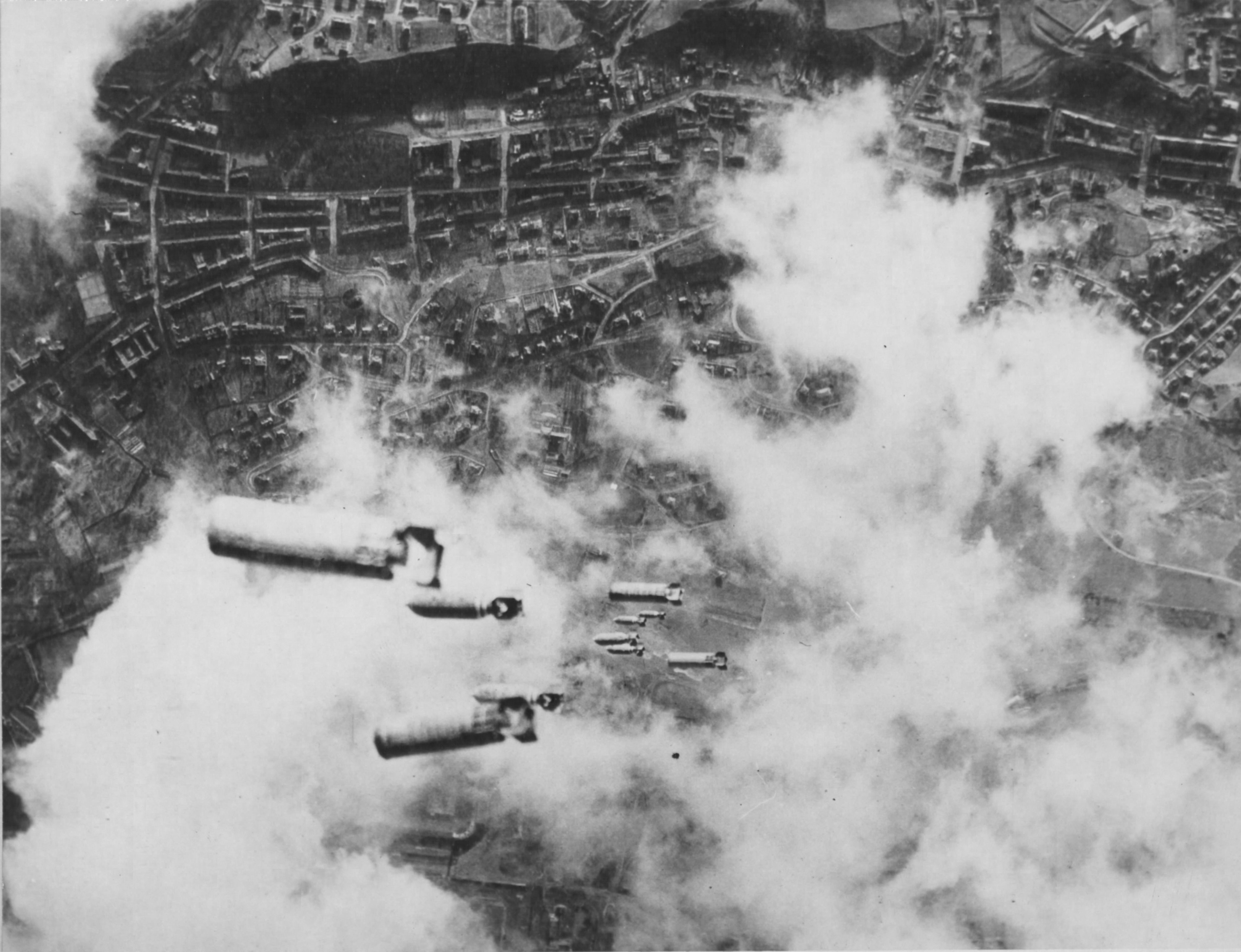
 As soon as he heard that permission had been given to destroy Dresden, Air Marshal Harris decided to achieve this by a deliberately created fire storm, and to increase the effect he persuaded the Americans to split the available bombers into three groups. The task of the first wave was to create the fire storm. Three hours later, a second and much heavier night force of British bombers was timed to arrive when the German fighter and flak defenses would be off guard, and the rescue squads on their way. Its task was to spread the fire storm. Finally, the next morning, a daylight attack by the Eighth Air Force was to concentrate on the outlying areas, the new city.
Two-pronged attacks had been successfully carried out during 1944 against a number of German towns. The three-pronged attack employed at Dresden was unique and uniquely successful. The first wave, consisting of some two hundred fifty night bombers, arrived precisely on time and duly created a fire storm. The second force — more than twice as strong and carrying an enormous load of incendiaries — also reached the target punctually, and, undisturbed by flak or night fighters, spent thirty-four minutes carefully spreading the fires outside the first target area. Finally, to complete the devastation, some two hundred eleven Flying Fortresses began the third attack at 11:30 a.m. on the following morning. Without exaggeration, the commanders could claim that the Dresden raid had “gone according to plan.” Everything which happened in the stricken city had been foreseen and planned with meticulous care.
 So far, we have been looking at the Dresden raid from “our own side of the hill” — considering the point of view of Mr. Churchill, concerned to create the best impression possible on Stalin at the Yalta Conference, and of Air Marshal Harris, eager to demonstrate the technique for creating a fire storm. But what was the impact on the Dresdeners? Inevitably the raid has created its own folklore. Thousands of those who survived it now live in Western Germany, each with his own memory to retail to the visitor. In Dresden itself, the city fathers have now established an official Communist version, of which the main purpose clearly is to put the main blame on the “American imperialists” (we are solemnly told, for instance, that the R.A.F. was directed to special targets in the city by an American capitalist whose villa on the far side of the Elbe is now a luxury club for favored Communist artists). Nevertheless, anyone who bothers to read the books published in both Germanies and to compare the stories he hears from Communist and anti-Communist witnesses soon discovers that not only the outline of events but the details of the main episodes are agreed beyond dispute.
Dresden is one of those German cities which normally devotes Shrove Tuesday to Carnival festivities. But on February 13, 1945, with the Red Army sixty miles away, the mood was somber. The refugees, who were crowded into every house, each had his horror story about Russian atrocities. In many parts of the city, and particularly around the railway station, thousands of latecomers who could find no corner in which to sleep were camping in the bitter cold of the open streets. The only signs of Carnival spirit, when the sirens sounded at 9:55 p.m., were the full house at the circus and a few gangs of little girls wandering about in fancy dress. Though no one took the danger of a raid very seriously, orders must be obeyed and the population just had time to get down to its shelters before the first bombs fell at nine minutes past the hour.
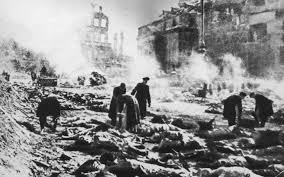
Twenty-four minutes later, the last British bomber was on its way back to England, and the inner city of Dresden was ablaze. Since there were no steel structures in any of its apartment houses, the floors quickly capsized, and half an hour after the raid was over the fire storm transformed thousands of individual blazes into a sea of flames, ripping off the roofs, tossing trees, cars and lorries into the air, and simultaneously sucking the oxygen out of the air-raid shelters.
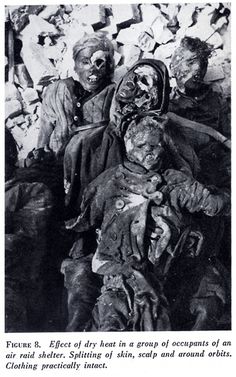
Most of those who remained below ground were to die painlessly, their bodies first brilliantly tinted bright orange and blue, and then, as the heat grew intense, either totally incinerated or melted into a thick liquid sometimes three or four feet deep. But there were others who, when the bombing stopped, rushed upstairs. Some of them stopped to collect their belongings before escaping, and they were caught by the second raid. But some 10,000 fled to the great open space of the Grosse Garten, the magnificent royal park of Dresden, nearly one and a half square miles in all.
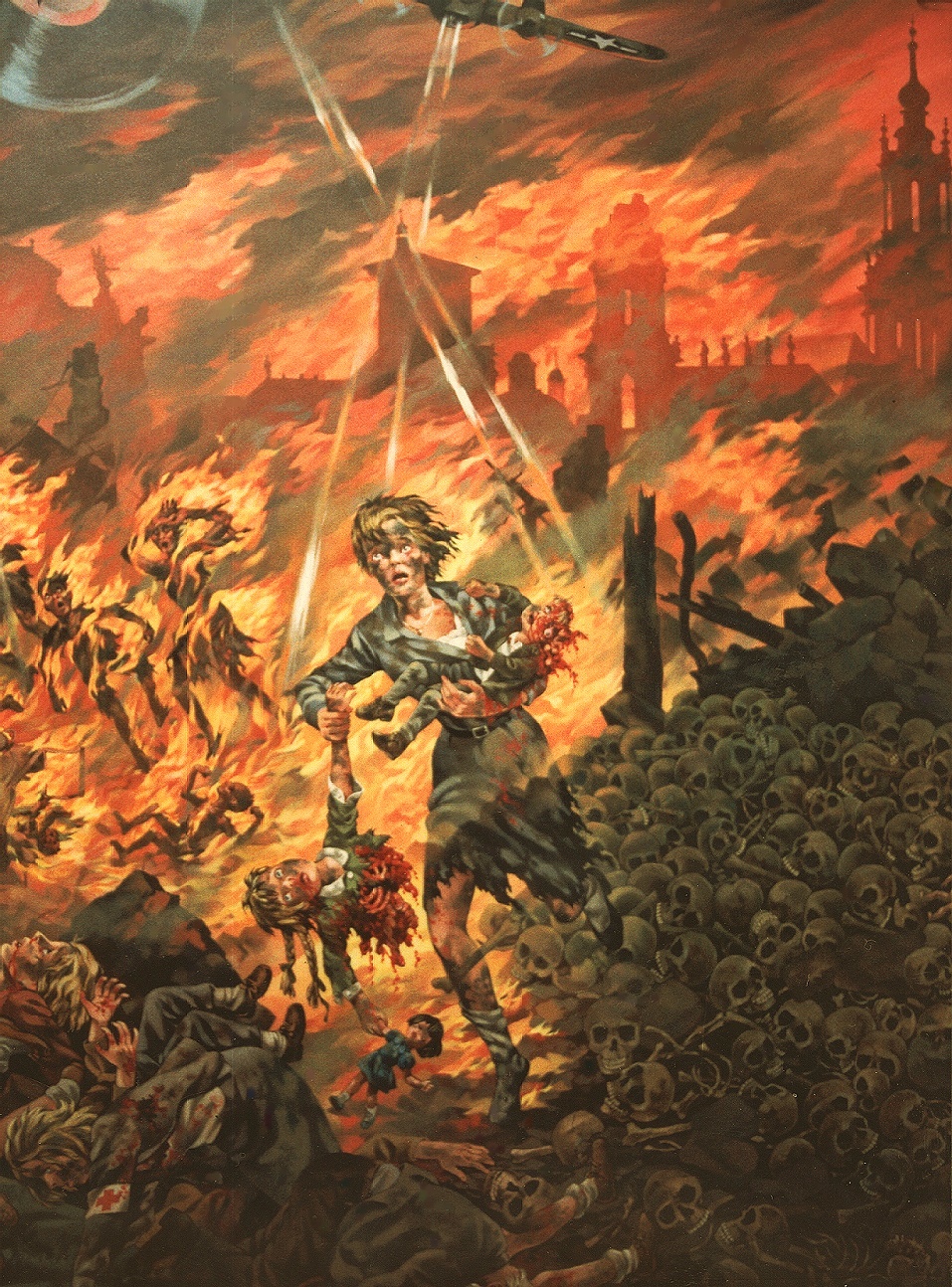
Here they were caught by the second raid, which started without an air-raid warning, at 1:22 a.m. Far heavier than the first — there were twice as many bombers with a far heavier load of incendiaries — its target markers had been deliberately placed in order to spread the fires into the black rectangle which was all the airmen could see of the Grosse Garten. Within minutes the fire storm was raging across the grass, ripping up some trees and littering the branches of others with clothes, bicycles and dismembered limbs that remained hanging for days afterward.
Equally terrible was the carnage in the great square outside the main railway station. Here, the thousands camping out had been reinforced by other thousands escaping from the inner city, while within the station a dozen trains, when the first sirens blew, had been shunted to the marshaling yards and escaped all damage. After the first raid stopped, these trains were shunted back to the station platforms — just in time to receive the full force of the bombardment. For weeks, mangled bodies were littered inside and outside the station building. Below ground, the scene was even more macabre. The restaurants, cellars and tunnels could easily have been turned into effective bombproof shelters. The authorities had not bothered to do so, and of the two thousand crowded in the dark, one hundred were burned alive and five hundred asphyxiated before the doors could be opened and the survivors pulled out.
The timing of the second raid, just three hours after the first, not only insured that the few night fighters in the area were off their guard, but it also created the chaos intended and effectively interrupted all rescue work. For many miles around, military detachments, rescue squads and fire brigades started on their way to the stricken city, and most of them were making their way through the suburbs when the bombs began to fall. Those who turned back were soon swallowed up in the mad rush of panic evacuation. Most of those who proceeded toward the center perished in the fire storm.
The most terrible scenes in the inner city took place in the magnificent old market square, the Altmarkt. Soon after the first raid finished, this great square was jam-packed with panting survivors. When the second raid struck, they could scarcely move until someone remembered the huge concrete emergency water tank that had been constructed to one side. This tank was a hundred by fifty yards by six feet deep. There was a sudden stampede to escape the heat of the fire storm by plunging into it. Those who did so forgot that its sloping sides were slippery, with no handholds. The nonswimmers sank to the bottom, dragging the swimmers with them. When the rescuers reached the Altmarkt five days later, they found the tank filled with bloated corpses, while the rest of the square was littered with recumbent or seated figures so shrunk by the incineration that thirty of them could be taken away in a single bathtub.
 But perhaps the most memorable horror of this second raid occurred in the hospitals. In the last year of the war, Dresden had become a hospital city, with many of its schools converted into temporary wards. Of its nineteen hospitals, sixteen were badly damaged and three, including the main maternity clinic, totally destroyed. Thousands of crippled survivors were dragged by their nurses to the banks of the River Elbe, where they were laid in rows on the grass to wait for the daylight. But when it came, there was another horror. Punctually at 11:30 a.m., the third wave of bombers, the two hundred eleven American Flying Fortresses, began their attack. Once again, the area of destruction was extended across the city. But what the survivors all remember were the scores of Mustang fighters diving low over the bodies huddled on the banks of the Elbe, as well as on the larger lawns of the Grosse Garten, in order to shoot them up. Other Mustangs chose as their targets the serried crowds that blocked every road out of Dresden. No one knows how many women and children were actually killed by those dive-bombing attacks. But in the legend of Dresden destruction, they have become the symbol of Yankee sadism and brutality, and the inquirer is never permitted to forget that many choirboys of one of Dresden’s most famous churches were among the victims.
For five days and nights, the city burned and no attempt was made to enter it. Then at last the authorities began to grapple with the crisis and to estimate the damage. Of Dresden’s five theatres, all had gone. Of her fifty-four churches, nine were totally destroyed and thirty-eight seriously damaged. Of her one hundred thirty-nine schools, sixty-nine ceased to exist and fifty were badly hit. The great zoo which lay just beyond the Grosse Garten had been struck in the second raid, and the panicked animals had mingled with the desperate survivors. Now they were rounded up and shot. Those who escaped from the prisons, when they too were blown up, had better fortune: they all managed to get away, including a number of brave anti-Nazis.
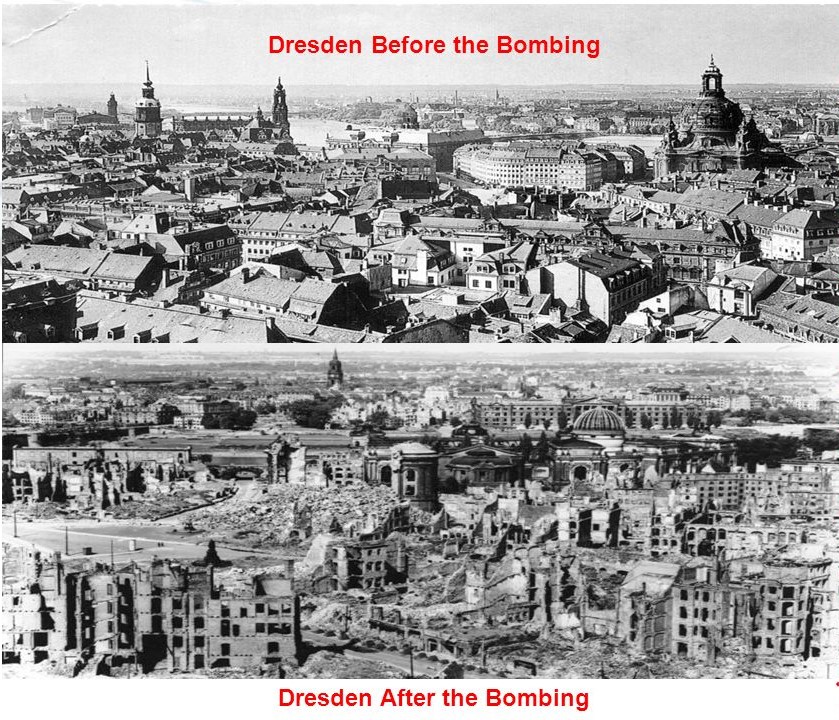 But some things had survived destruction. The few factories Dresden possessed were outside the city center, and soon were at work again. So too was the railway system. Within three days, indeed, military trains were running once again right through the city, and the marshaling yards — untouched by a bomb — were in full operation. It was as though an ironical fate had decided that the first fire storm deliberately created by mortal man should destroy everything worth preserving, and leave untouched anything of military value.
In their salvage work, the Nazis relied on some 25,000 Allied prisoners of war, concentrated in and around the city. Dresden, as was known very well in London and Washington, was not only a hospital city but a prisoner-of-war city — still another reason why the authorities assumed it would not be attacked. Faced with the appalling scenes of suffering, the prisoners seemed to have worked with a will, even after some of their fellow-prisoners had been shot under martial law for looting.
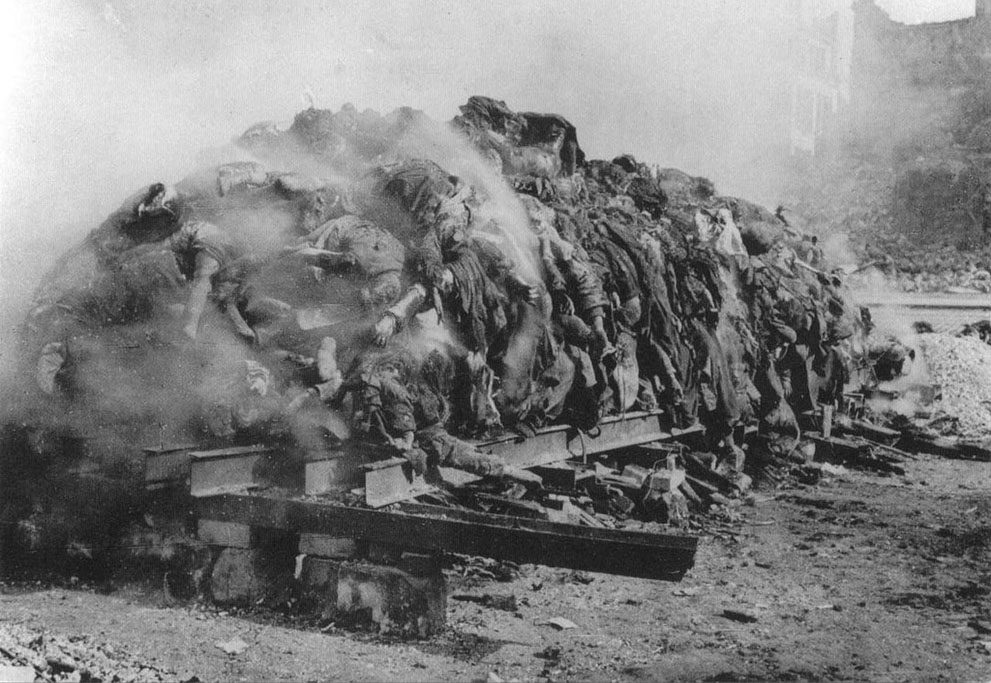
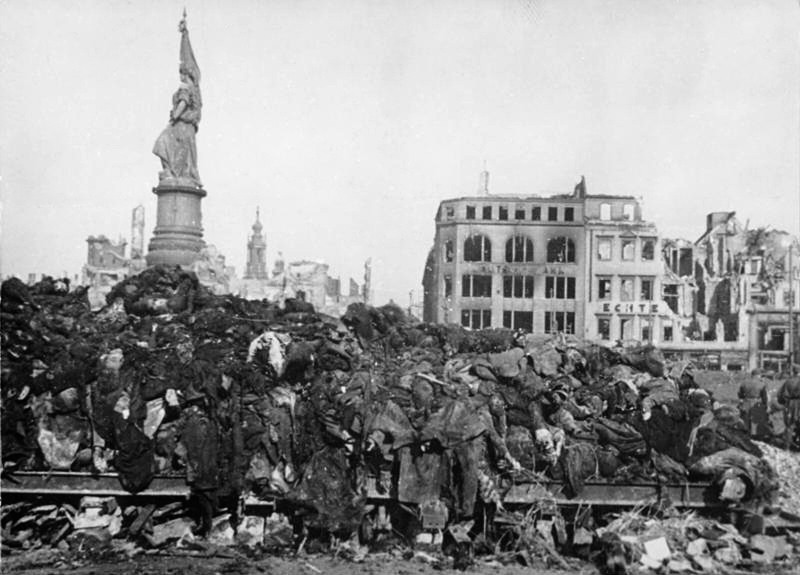
What Dresdeners chiefly remember, of these first days after the raid, is the disposal of the bodies. Throughout the war, German local authorities had been extremely careful to show great respect for death, enabling relatives wherever possible to identify and to bury their own dead. At first, this procedure was followed in Dresden. But weeks after the raid there were still thousands of unopened cellars under the smoldering ruins, and the air was thick with the fog and sweet stench of rotting flesh. An S.S. commander made the decision that the daily procession of horse-drawn biers from the city to the cemeteries outside must be stopped. If plague was to be prevented, the rest of the corpses must be disposed of more speedily. Hurriedly, a monstrous funeral pyre was constructed in the Altmarkt. Steel shutters from one of Dresden’s biggest department stores were laid across broken slabs of ironstone. On this macabre gridiron, the bodies were piled with straw between each layer, soaked with gasoline and set ablaze. Nine thousand corpses were disposed of in this way, and eight cubic meters of ash were then loaded into gasoline containers and buried in a graveyard outside the city, twenty-five feet wide and fifteen feet deep.
If it was expected in either London or Washington that the destruction of Dresden, despite its negligible military significance, would at least shatter German morale, this hope was soon to be disappointed — thanks to Paul Joseph Goebbels’ skillful exploitation of the disaster. For days, the Propaganda Ministry in Berlin poured out, both in its foreign and in its home services, a stream of eyewitness accounts of the stricken city, backed up by moralistic attacks on the cold-blooded sadism of the men who created the fire storm. In his secret propaganda, Dr. Goebbels did even better by leaking to the neutral press a fictitious top-secret estimate that the casualties had probably reached 260,000. As a result of this Nazi propaganda campaign, the German people were convinced that the Anglo-American forces were indeed bent on their destruction. And their morale was once again stiffened by terror of defeat.
 Disturbed by the success of Dr. Goebbels’ propaganda, the airmen decided to call a press conference on February 16 at SHAEF. As a result of the briefing, given by a British Air Commodore, Associated Press cabled a special dispatch all over the world, announcing “the long-awaited decision to adopt deliberate terror bombings of German population centers as a ruthless expedient of hastening Hitler’s doom.” The correspondents added that the Dresden attack was “for the avowed purpose of heaping more confusion on Nazi road and rail traffic, and to sap German morale.”
When this dispatch reached London, it was immediately censored on the ground that officially the R.A.F. only bombed military targets, and the attribution to it of terror raids was a vicious piece of Nazi propaganda. In the United States, where the dispatch was widely publicized, the embarrassment caused to the Administration was acute, since the Air Force spokesmen had seldom failed to point out the difference between the indiscriminate R.A.F. night attacks and the selective and precise nature of the daylight bombing carried out by the Eighth Air Force.
In order to stop awkward questions, General George C. Marshall then gave a public assurance that the bombing on Dresden had taken place at Russian request. Although no evidence was produced either then or since for the truth of this statement, it was accepted uncritically and has since found its way into a number of official American histories.
 But suppression was not sufficient to stem the rising wave of public protest. Coming as it did when the war was virtually over, the wanton destruction of the Florence of the North and the mass murder of so many of its inhabitants was too much, even for a world public opinion fed for years on strident war propaganda. The publication of a lengthy report by a Swedish correspondent caused a revulsion of feeling.
Within a few weeks, this revulsion against indiscriminate bombing had affected even Sir Winston Churchill. Up till now, the critics in the British Parliament of area bombing had been a small derided minority. Suddenly, their influence began to grow, and on March 28, Sir Winston in response to this new mood, wrote to the Chief of the Air Staff, beginning with the remarkable words:
“It seems to me that the moment has come when the question of bombing of German cities simply for the sake of increasing the terror, though under other pretexts, should be reviewed.”
Since the Premier had taken the lead in demanding the switch from target to area bombing and had actively encouraged each new advance proposed by Air Marshal Harris in the technique of air obliteration, this memorandum could hardly have been less felicitously phrased. It provided damning evidence that so long as terror bombing was popular, the politicians would take credit for it; but now that public opinion was revolting against its senseless brutality, they were only too obviously running for cover and leaving the air force to take the blame.
So outraged was the Chief of the Air Staff that on this occasion he stood up to Sir Winston, forcing him to withdraw the memorandum, and to substitute for it what the official historians — who narrate this incident in full — have described as “a somewhat more discreetly and fairly worded document.”
But in Britain at least the damage had already been done. From that moment, Bomber Command, which for years had been the object of adulation, became increasingly discredited, and the nickname of its Commander in Chief changed from “Bomber” Harris to “Butcher” Harris. Although the bomber crews, suffered far the heaviest casualties of any of the British armed services, no campaign medal was struck to distinguish their part in winning the war. In his victory broadcast of May 13, 1945, Sir Winston omitted any tribute to them, and after the Labour Government came to power, Earl Attlee was just as vindictive. In January, 1946, he omitted their Commander in Chief from his victory honors list. Sir Arthur Harris accepted the insult loyally, and on February 13 sailed to exile in South Africa.
 The Eighth Air Force was treated more gently, both by the politicians in Washington and by the American public. Its airmen received their share of campaign medals, and to this day it has never been officially admitted that by the end of the war they were bombing city centers and residential areas as wantonly by day as the R.A.F. was by night. There was, however, an important difference between the public image of the two Air Forces. The British Cabinet, having secretly decided to sanction indiscriminate terror bombing, concealed this decision from the British public and therefore compelled Bomber Command to operate under cover of a sustained and deliberate lie. In the case of the Eighth Air Force, self-deception took place of lying. Instead of doing one thing and saying another, the myth was maintained that on every mission the Flying Fortresses aimed exclusively at military targets, and this is still part of the official American legend of World War II. It was because it was impossible to square this legend with what had happened at Dresden that General Marshall had to excuse American protestation in that holocaust on the fictitious ground that the Russians had requested the attack.
I leave it to the reader to decide which form was more nauseating — British lying or American self-deception. For what concerns me in this inquiry is not the public image of Anglo-American idealism that was shattered by the Dresden raid, but the crime against humanity which was perpetrated. That it was decided to bomb a city of no military value simply in order to impress Stalin. That a fire storm was deliberately created in order to kill as many people as possible, and that the survivors were machine-gunned as they lay helpless in the open — all this has been established without a shadow of a doubt. What remains is to ask how decent, civilized politicians enthusiastically approved such mass murder and decent, civilized servicemen conscientiously carried it out.
The usual explanation — or excuse — is that strategic bombing was only adopted by the Western powers as a method of retaliation in a total war started by totalitarians. This is at best a half-truth. The Nazis and the Communists dabbled in terror raids on civilian targets. But they were old-fashioned and imperialist enough to hold that the aim of war is not to destroy the enemy, but to defeat his armies in the field, to occupy his country, and exploit its resources. That is why both Stalin and Hitler preferred to use their air power, not as a separate weapon of unlimited war, but as a tactical adjunct to conventional land and sea operations. In fact, the only nations which applied the theory of unlimited war really systematically were the two great Western democracies. Both created a gigantic strategic air force and carried out quite separate but eventually unsuccessful attempts to defeat Germany by aerial annihilation.
Yet, at first sight, terror bombing seems to me, as an Englishman, a form of warfare repugnant to our national temperament, and utterly unsuited to an island people, itself hopelessly vulnerable to indiscriminate air attack. And I suspect that most Americans also feel that it does not conform with the traditions of the American way of life.
Why then did both nations adopt it?
I believe that the motive which prompted us was a very characteristic Anglo-Saxon desire to defend ourselves without preparing for war to win the fruits of victory; without actual fighting, and (if this proved impossible) at least to keep casualties down to a minimum among our own soldiers. Not only do British and American fighting men demand a far higher standard of living than most of their enemies. Even more important, they insist that they should not be required to risk death in close combat if remote-control methods of destroying the enemy are available. That, I am sure, is the main reason why our politicians and generals felt morally justified in conducting a bomber offensive against Germany which culminated in the destruction of Dresden.
Once we see this, we are no longer surprised that, as soon as an atomic bomb had been perfected, President Truman decided, with the full approval of the British Prime Minister, to use it. In this way, he could finish off the Japanese without a landing that would have cost thousands of American lives!
The moral I draw from the terrible story of Dresden is that the atom bombs employed on Hiroshima and Nagasaki did not inaugurate a new epoch in the history of war. They merely provided a new method of achieving victory without the casualties involved in land fighting far more deadly and far more economical than the thousand-bomber raid of World War II. Here, our politicians and generals felt, was the ultimate weapon which would enable the democracies to disarm and to relax — yet deter aggression.
Alas! Nearly twenty years of bitter experience have taught us that the world was not made safe for democracy either by the “conventional” fire storm created by the bombers in Dresden, or by the atomic fire storm of Hiroshima. Even in modern war, crime does not always pay!